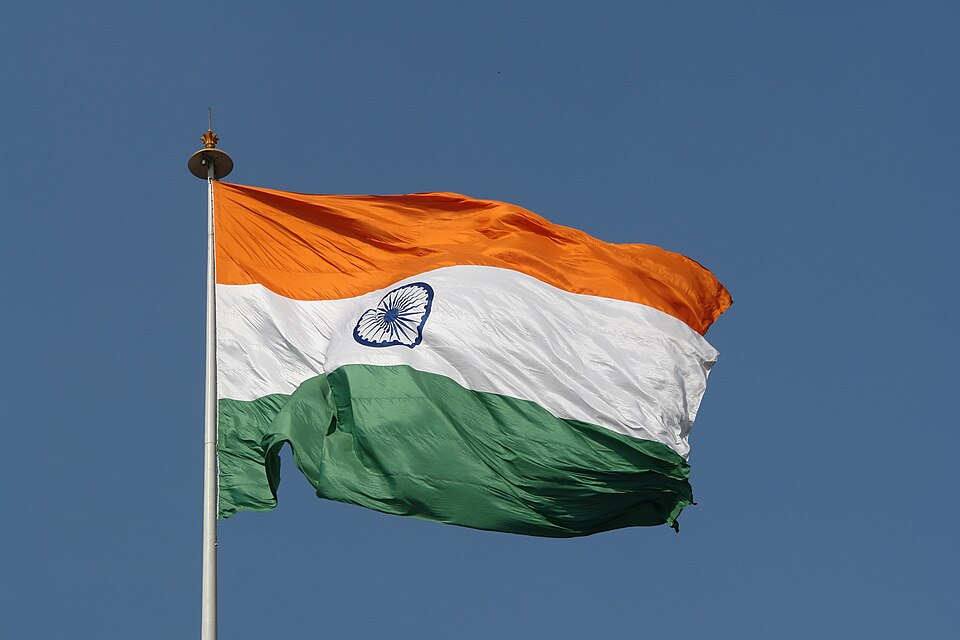
Photo: Yann Forget · CC BY-SA 4.0
Geography and Location
India is strategically located in South Asia, positioned between approximately 8°4' and 37°6' North latitude and 68°7' and 97°25' East longitude. This vast nation shares borders with six countries: Pakistan (2,912 km), China (3,380 km), Nepal (1,690 km), Bhutan (605 km), Bangladesh (4,053 km), and Myanmar (1,463 km). The country is bounded by the Arabian Sea to the west, the Bay of Bengal to the east, and the Indian Ocean to the south, with a stunning coastline stretching over 7,516 kilometers.
Size and Area
With a total area of 3,287,263 square kilometers, India ranks as the 7th largest country in the world by land area. To put this in perspective, India is roughly one-third the size of the United States. The country's land area covers 2,973,190 square kilometers, while water bodies account for 314,073 square kilometers, including rivers, lakes, and coastal waters.
Climate and Terrain
India's climate is remarkably diverse, ranging from tropical monsoon conditions in the south to temperate climates in the northern regions. The country experiences four main seasons: winter (December-February), summer (March-May), monsoon (June-September), and post-monsoon (October-November). The monsoon season is particularly crucial, bringing 70-80% of the annual rainfall.
The terrain is equally varied, featuring:
- The towering Himalayas in the north, including Kanchenjunga (8,586m), India's highest peak
- The fertile Indo-Gangetic Plains across northern and central regions
- The ancient Deccan Plateau covering much of southern India
- Coastal plains along both eastern and western shores
- The Thar Desert in the northwest
Natural Resources and Environment
India is blessed with abundant natural resources, holding the world's fourth-largest coal reserves. Other significant resources include iron ore, bauxite, chromite, manganese, mica, natural gas, petroleum, limestone, and extensive arable land. Approximately 52.8% of India's land is suitable for agriculture, with 2.8% dedicated to permanent crops.
Environmental Challenges
Despite its natural wealth, India faces several environmental challenges:
- Air pollution in major cities, with several Indian cities ranking among the world's most polluted
- Water scarcity and pollution affecting over 600 million people
- Deforestation and soil erosion
- Natural disasters including cyclones, floods, droughts, and earthquakes
- Climate change impacts affecting monsoon patterns and agriculture
Population Demographics (2024-2025)
As of 2024, India has officially become the world's most populous country, with over 1.43 billion people, surpassing China. This represents a significant milestone in global demographics.
Age Distribution
India maintains a relatively young population profile:
- 0-14 years: 26.2% (approximately 375 million)
- 15-64 years: 67.2% (approximately 962 million)
- 65+ years: 6.6% (approximately 94 million)
The median age is approximately 28.2 years, making India one of the youngest major economies globally. The population growth rate has slowed to about 0.8% annually, indicating a demographic transition toward stability.
Practical Information
For visitors and residents, it's important to note that tap water is generally not safe to drink throughout most of India. Bottled or properly filtered water is recommended. The country operates on Indian Standard Time (IST), which is UTC+5:30, and uses a single time zone despite its vast geographical span.
India's diversity extends beyond geography to include 22 official languages, hundreds of dialects, and a rich tapestry of cultures, making it one of the world's most linguistically and culturally diverse nations.