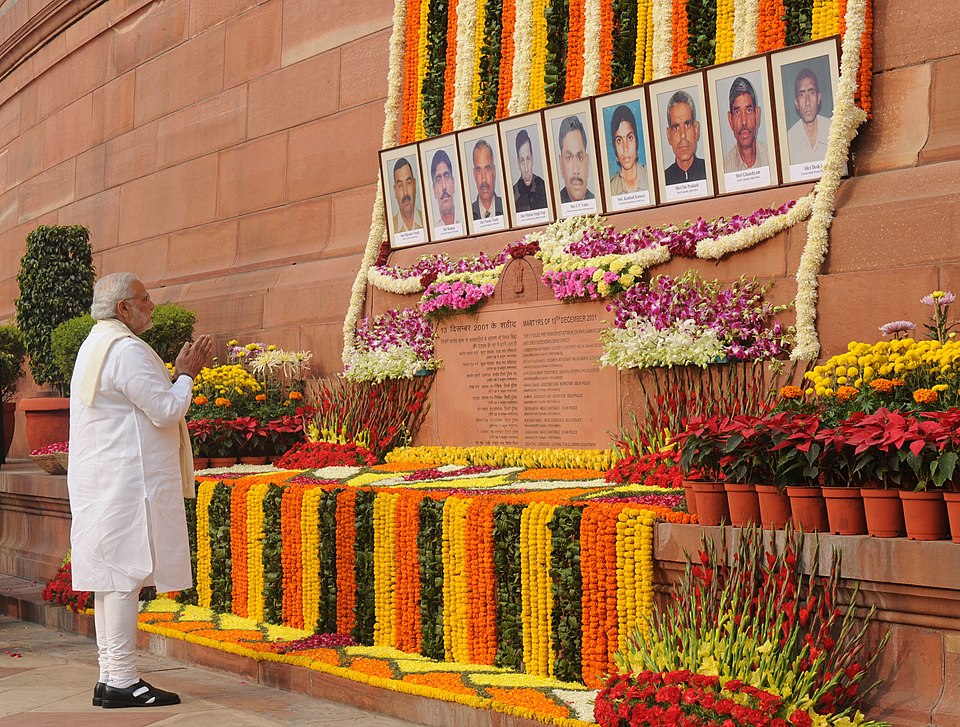
Photo: Prime Minister's Office, Government of India · GODL-India
India's Democratic Government Structure
India operates as the world's largest democracy, governing a union of 28 states and 8 Union Territories (UTs) as of 2025. The Republic of India's seat of government is located in New Delhi, where the Central Government exercises authority over this vast nation of over 1.4 billion citizens.
Three Pillars of Indian Democracy
The Indian government operates on the principle of separation of powers, divided into three distinct branches:
Executive Branch
The President of India serves as the constitutional head of state, while the Prime Minister leads the government as the head of the executive. The President exercises power directly or through subordinate officers, acting on the advice of the Council of Ministers headed by the Prime Minister. The current system ensures that executive power remains accountable to the legislature.
Legislative Branch
India's Parliament consists of two houses:
- Lok Sabha (House of the People): The lower house with 543 elected members representing constituencies across India
- Rajya Sabha (Council of States): The upper house with 245 members, representing states and union territories
General elections are held every five years, with the most recent parliamentary elections concluded in 2024, reaffirming India's commitment to regular democratic transitions.
Judicial Branch
India's judiciary operates independently and includes:
- The Supreme Court of India (apex court)
- 25 High Courts at state level
- District and subordinate courts handling civil, criminal, and family matters
Federal Structure and Local Governance
India follows a federal system where power is distributed between the Central Government and State Governments. Each state has its own government with executive, legislative, and judicial branches, allowing for regional autonomy within the national framework.
Panchayati Raj System
The 73rd and 74th Constitutional Amendments institutionalized local self-governance through the Panchayati Raj system. This three-tier structure includes:
- Gram Panchayats at village level
- Panchayat Samitis at block level
- Zilla Panchayats at district level
This system empowers over 250,000 local bodies across rural India, making democracy accessible at the grassroots level.
Constitutional Principles
India's Constitution, adopted in 1950, defines the nation as a Sovereign, Socialist, Secular, Democratic Republic:
- Sovereign: Complete independence in internal and external affairs
- Socialist: Commitment to social and economic equality, reducing wealth concentration
- Secular: No official state religion; equal treatment of all faiths
- Democratic: Government by elected representatives of the people
- Republic: Head of state is elected, not hereditary
Legal System and Framework
India's legal system is based on English Common Law and Parliamentary legislation. Key legal codes include:
- The Indian Penal Code (IPC)
- The Civil Procedure Code
- The Criminal Procedure Code
India accepts the jurisdiction of the International Court of Justice with certain reservations, demonstrating its commitment to international legal cooperation.
Democratic Participation and Elections
With over 970 million registered voters as of 2024, India conducts the world's largest democratic exercise during general elections. The Election Commission of India, an independent constitutional body, oversees free and fair elections using Electronic Voting Machines (EVMs) and Voter Verifiable Paper Audit Trails (VVPATs) to ensure transparency and accuracy.
India's democratic system continues to evolve, balancing the needs of diverse linguistic, religious, and cultural communities while maintaining national unity and constitutional governance.